
Imagine you spent most of the week helping a client find a home they can move into without taking on more finishing work. By Friday, you have agreed on a Saturday inspection, sent the photographs and answered questions about a property that came through a colleague. Then you call to confirm access and discover that the unit was reserved the previous afternoon. The alternative being offered is a finished shell, although your client has already explained why that will not work for them.
While you are trying to find another option, you also need to settle who will speak to the buyer and how you and the agent with the direct brief will be paid. Your client is still expecting an inspection, the old advert is still on your website, and the colleague helping with follow-up cannot see the promises you made on WhatsApp. Keeping the property information, the buyer’s brief and everyone’s responsibilities connected has become part of the work of serving that one client.
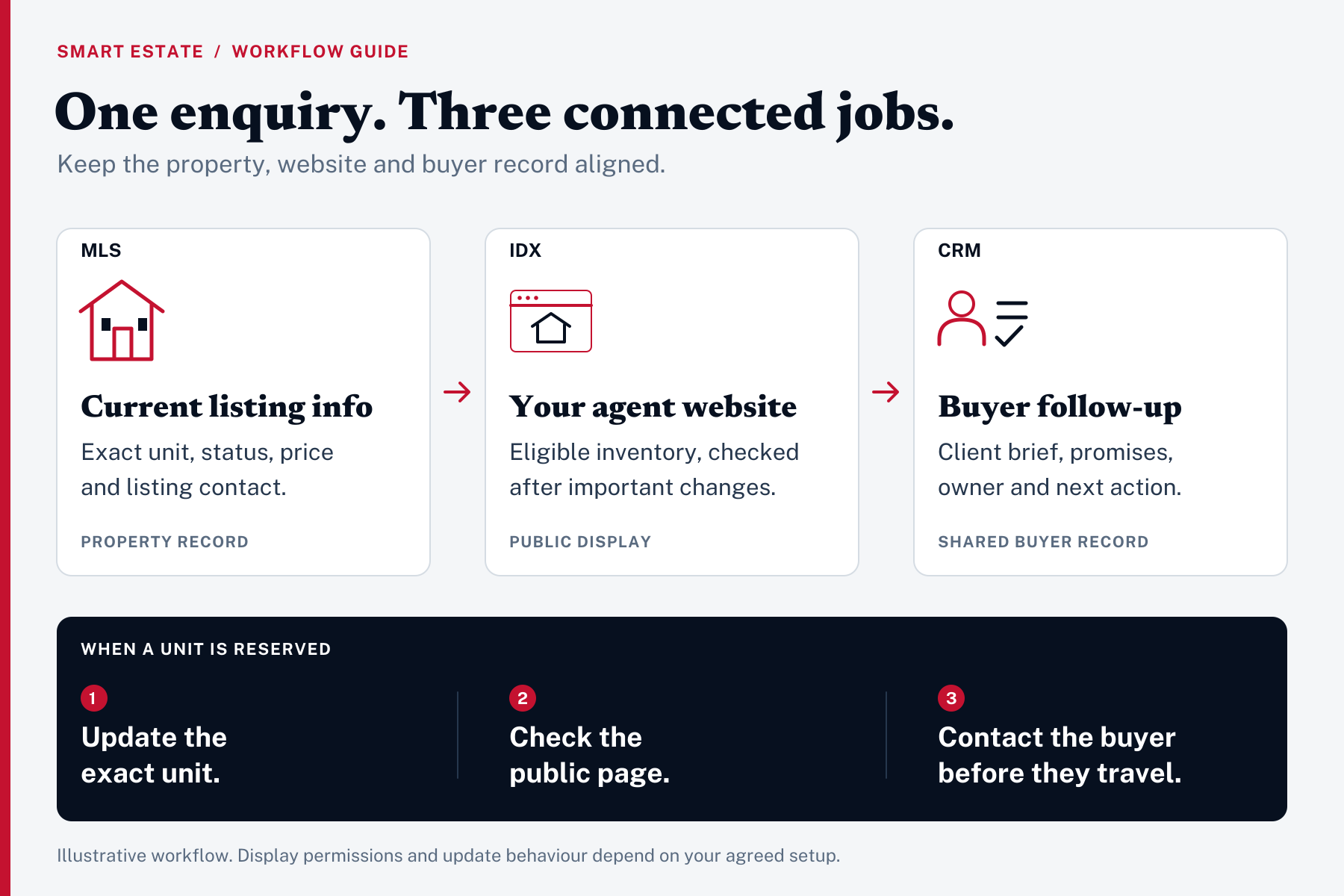
For this enquiry, three jobs now need doing: correct the property record, check the advert and help the buyer find a workable alternative. The MLS provides a shared property record and a way to identify the listing contact. IDX allows eligible inventory to appear on a participating agent’s website. The CRM keeps the buyer’s requirements, conversations and next actions together. When information changes, the question is whether the right people can see the change and act on it before the buyer makes an unnecessary journey.
The questions behind the enquiry
In a public account of buying property in Abuja, a Reddit contributor describes receiving homes outside their budget, viewing properties that did not match the photographs and discovering differences between a finished shell and a carcass. They also describe having to deal with another agent to view that agent’s property, and suspect commission concerns are making cooperation difficult. It is one person’s experience, but the questions it raises are practical: does the property fit the brief, who can confirm the facts, and what happens when another agent has the right property?
Other public discussions add different parts of the problem. A September 2026 Lagos rental account distinguishes the advertised rent from the total package the house-hunter is expected to pay, while a July 2026 comment about an inspection in Uyo describes arriving to find the gate locked. These rental accounts do not establish how often the same problems occur in purchases. They do show why a useful property workflow needs to carry information about known costs and confirmed access, alongside the photographs and asking price.
What the MLS should help you establish
MLS means multiple listing service. It makes property information available within a network of participating professionals so they can discover inventory and cooperate around it. For an agent working on a client’s requirement, the starting point is a specific property record and an identifiable listing contact. If you need a fuller introduction to the concept, our guide explains how an MLS works in Nigeria.
A listing reference is particularly useful when a brief has passed through several agents. The colleague who forwarded it may have to call someone else for the current price, and that person may need to reach the agent handling the property. Keeping one reference attached to the conversation helps everyone establish which property, development and unit they mean, rather than relying on a photograph or a loosely described location.
The underlying record still needs accurate information. A three-bedroom flat, a terrace and a detached house are different propositions, as are an off-plan unit, a carcass, a finished shell and a home ready for occupation. Explain the present condition and what the quoted price includes instead of expecting the label to answer every question. Use photographs of the actual unit, or clearly identify a show house, proposed finish or artist’s impression.
Availability, asking price, floor or land area with its units, known additional charges and the responsible listing contact should be clear enough for another agent to assess the property against a client’s brief. Keep the checks in proportion: a complete listing helps explain what is being marketed, and an agent check helps establish identity and authority. Title and transaction due diligence remain separate professional work; neither a platform badge nor a successful inspection settles them.
How IDX connects the listing to your website
IDX means Internet Data Exchange. It allows eligible MLS listings to appear on a participating agent’s website under the applicable permissions. You can therefore present suitable stock beyond the properties you personally listed, while working from the underlying MLS information. Our guide to using IDX on your property website covers the setup and presentation in more detail.
With Smart Estate IDX, enquiries submitted through your website’s configured lead form go to you, as described in that guide. You can discuss the requirement with the buyer and approach the listing agent about the property. Keep that form-specific route distinct from other ways a buyer might make contact, including an enquiry made directly on the MLS, and test the entry points your business actually uses.
Permission to display a property does not give you authority to conclude its sale or settle the commercial arrangement with the listing agent. It also does not prevent the buyer from choosing whom to work with. What the website gives you is a place to present eligible inventory and begin a relevant conversation. During setup, establish how changes to price or availability reach that page, who checks the result and what happens if the display is out of date.
What belongs in the CRM after the enquiry arrives
CRM means customer relationship management. For a property team, the record needs to go beyond a name and telephone number: an authorised colleague should be able to understand what the client wants, what has been discussed, what was promised and what needs to happen next. If the client has ruled out taking on construction work, that requirement should remain visible when another agent sends an attractive-looking carcass within budget.
Record the preferred locations, budget range, property type, completion level and timing, together with the properties already considered and why they were declined. Give the next action a person responsible and a date. A note asking a colleague to confirm the service charge and send the current breakdown before Friday’s inspection is much easier to act on than a reminder that simply says “follow up”.
Your team can continue speaking with clients on WhatsApp. Agree which important details must also reach the shared record, such as a changed requirement, an agreed cost, a promised document or an inspection arrangement. A website form, a WhatsApp conversation and a viewing can concern the same buyer, so establish how the team connects them, what the software captures automatically and what someone must enter. Access to the record should follow each person’s role, rather than exposing the buyer’s details to everyone involved in marketing the property.
What to update when a unit is reserved
Return to the Saturday inspection in the opening. Once the listing agent confirms that the exact unit is reserved, the property record needs the appropriate status under the platform’s rules. Be precise about which unit has changed: a reservation on one flat does not mean every flat in the development is unavailable. The person responsible for the listing should record the change and make sure the collaborators who need it are informed.
The website then needs to reflect the change according to its display permissions and update process. Check what a visitor actually sees rather than assuming that an edit has reached every page immediately. Depending on the setup and status rules, the unit might be removed from active results or shown with a changed status. Establish the expected behaviour in advance so an outdated page does not continue inviting inspections for a unit that cannot be offered.
The buyer conversation also needs attention. Identify the affected enquiry in the CRM, record what has changed and assign someone to contact the client before they travel. Preserve the original requirement when considering an alternative; offering a finished shell does not resolve the problem for a client who needs a home ready for occupation. Once another suitable unit is found, confirm its current details and access before arranging a replacement visit.
Other changes follow the same distinction. If the buyer changes their budget, update the buyer brief rather than the public asking price. If an accurate property is unsuitable because of the client’s preferences, record the reason in the CRM rather than changing the listing to make it seem suitable. If the photographs are wrong, correct the property information and check the affected website display. These are different corrections, even when they arise from the same inspection.
One enquiry, three coordinated jobs. Display permissions and update behaviour depend on the agreed setup.
Leave a handoff your colleague can use
A useful handoff should let the next person continue without asking the buyer to repeat the entire conversation. For the illustrative Saturday enquiry, the record could explain that the buyer wants a completed three-bedroom flat within the agreed area and budget; the original unit is now reserved; a shell option has already been declined; and a named colleague will confirm a suitable alternative and inspection access before calling the buyer back at the agreed time.
Alongside that summary, retain the property reference, the authorised listing contact, the last availability confirmation, known charges and outstanding questions. Record who will communicate with the buyer and what information may be shared with the other agent. Use the fields and notes your CRM supports, and make clear which details have been confirmed and which still need checking.
Agree the collaboration while the opportunity is still clear
An agent who has paid for advertising and spent time understanding a buyer’s requirement has a legitimate concern about being left out of the transaction. So does the agent who secured the instruction and prepared the property for market. A workable process needs to address both contributions while keeping the buyer informed about whom they are dealing with and what charges apply.
Start by identifying the arrangement. Co-broking on a specific opportunity involves an agent who already has a buyer; co-marketing can begin earlier, when another agent wants permission to promote the listing. A developer may appoint several marketers for a project, which requires clarity about available units, approved information and each marketer’s authority. Do not assume that every development is being sold under one agent’s exclusive mandate.
Before an introduction, record the property and parties involved, the work each person will do, the agreed fee or sharing basis, who is responsible for payment, when it becomes due and how changes will be handled. If you are seeking permission to promote first, also agree the price and media you may use and the route for new enquiries. Have terms reviewed by an appropriate professional where needed. A software record can help retain context, but it does not turn an unclear agreement into a payment guarantee.
Choosing what your business needs first
For a solo agent with an active network and no website, the immediate problem may be finding suitable stock and reaching the right listing contact. Improving the inventory and collaboration process can be the sensible first step, with a disciplined client record alongside it. IDX is relevant when there is a website on which to present eligible inventory; it need not be the first purchase simply because it appears beside MLS and CRM in a product discussion.
An agency with a functioning website may have a different problem: the site shows little of the inventory the team can legitimately offer, while staff are manually preparing separate adverts. That is a reason to assess IDX, including its eligibility, display and update rules. If suitable enquiries already arrive but conversations disappear between agents, prioritise the shared buyer record, responsibilities and follow-up instead of expecting more inventory to solve it.
For a developer working with in-house staff and external marketers, start by clarifying the unit-level information, who is allowed to promote it and how changes reach those people. The buyer-facing record then needs to preserve the enquiry and commitments made by the sales team. Several tools may be useful, but the first decision should follow the work that is breaking down and the people who need to do it.
Use the walkthrough to test the work
Bring one representative listing and an anonymised buyer enquiry to a Smart Estate walkthrough. Ask to see the property reference on the website enquiry and where that enquiry arrives. Then change a test unit’s status and check the MLS record and public display against the behaviour promised for that setup. The test is incomplete if the team can only show the edit screen without showing what a buyer would see afterwards.
In the walkthrough of Smart Estate’s real estate CRM, ask an authorised colleague to take over the test enquiry. They should be able to explain the buyer’s requirement, the property already considered, the outstanding question and the next action using the record available to them. Also establish how an inspection’s access arrangements are confirmed, so an appointment in a calendar is not mistaken for assurance that someone will open the gate.
Finally, agree who will maintain the listing information, check important changes and keep the buyer updated. That is how the three systems become part of a dependable working process. When the next property is reserved or the buyer changes their mind, your team should know what to correct, whom to contact and how to continue the conversation without starting again.